
Audit Thyself?
AI models can’t grade their own blind spot very well. People don’t either.

One signal 🔭 One subtraction ➖ One analogy ⚡
Created by Sam Rogers, building PAICE.work | Freely available on Substack and LinkedIn | New issue every week
🔭 Signal: One Read, Confidently Wrong
Does anybody ship a single model on the hard questions anymore? I hope not. Those who know what they’re doing with AI run a second one to check the first. Or they convene a council and let them disagree, because one model’s blind spot is mostly invisible from inside that model. The whole point of the second voice is to see what the first one structurally can’t.
A solo-authored essay has the identical flaw. For fifty-six issues I’ve walked into other people’s blind spots and named those, but it’s very hard to name my own. One confident voice reads as coverage. But it’s just one read.
It’s also slow: by the time a single voice polishes a take to shipping smoothness, the machine-speed news has already moved.
The org-scale version is measurable. The best data we have is last year old, when 71% of organizations were using generative AI in at least one business function (Stanford AI Index 2025), and I’m betting it’s gone up since then. Yet only about 1 in 5 orgs have a mature model for governing it (Deloitte 2026). Adoption is the fast, confident first read. Judgment is the dissent nobody convened. The gap between the two is a mono-model running unaudited at company scale, and that is the most expensive thing on this list.
One voice is not a viewpoint. It is an unaudited model.
➖ Subtraction: The Solo Approval
Find your highest-stakes recurring output, the one that currently passes through exactly one human reviewer. Stop confusing “one person signed off” with “this was actually checked.” A single signer is not an audit. Too often it’s little more than a second copy of the first (increasingly AI generated) opinion.
The solution isn’t to add another proofreader who blesses the work that looks done. It’s to add a second voice whose only job is to disagree, to find the seam the first read went blind to.
Make it measurable this week: name one decision that has exactly one set of eyes on it. Give it a second set, briefed to dissent instead of approve. Count how many times the dissent changes the output of the call. That number is the audit you were missing.
⚡ Analogy of the Week: The Tumor Board
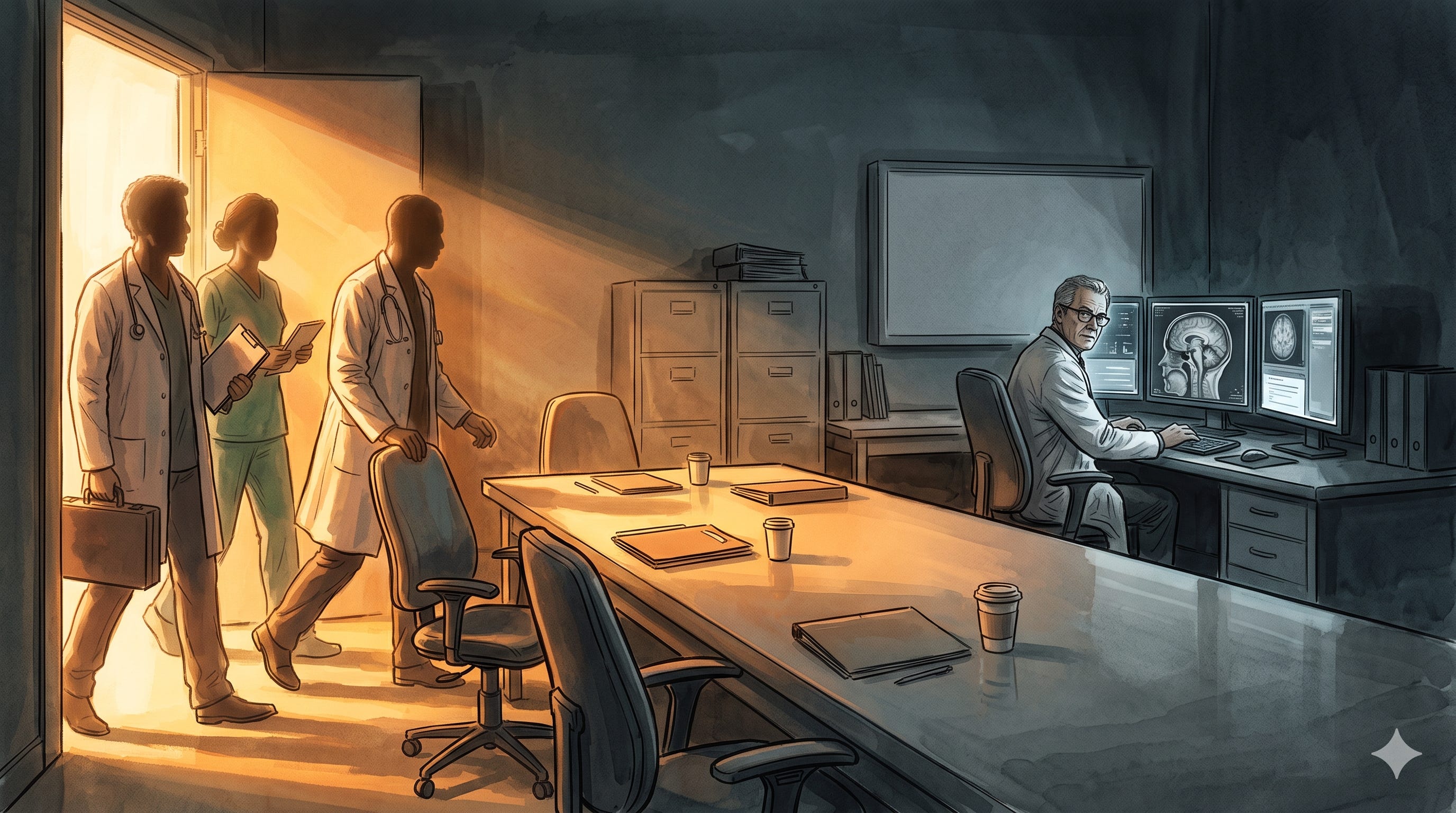
Walk into a hospital on the hard cases and what you will not find is one brilliant doctor making the call all alone. You will find a room. Oncologist, radiologist, surgeon, pathologist, all reading the same scans, all arguing about the case.
Not because any one of them is weak as an individual. Because any individual is structurally not strong enough for a disease that hides in the seam between specialties, exactly where a single expert’s training stops. The room exists to catch what one set of eyes, however good, cannot catch by itself. The board is slower than a single glance. That is a feature, not a bug. Fast and confident is precisely how the hard ones get missed.
The insurance industry would have condensed this down to save costs long ago, if possible. A single read is quick, but the board is right more often. When the stakes are real, even the actuarial tables agree: right is more valuable than quick.
🎵 Closing: The Solo Subtraction
By my own argument, my solo perspective is the form to subtract. So I am convening the board.
This week, Signals & Subtractions is becoming a live show. Better signals, and the clarity to stop what no longer serves. Live on Wednesdays (LinkedIn, Substack, YouTube), a polished cut on Fridays (more platforms), and this newsletter is about to become the Sunday recap. The format is the thesis: multiple voices every episode, me as host, a rotating cohost, and a guest, each bringing one signal and one subtraction. Tight, fast, current, human. Lecture-less, application-rich.
Who it’s for: Signals & Subtractions is still made to help the operator who is accountable for AI outcomes and risk and has been drinking from the daily-news firehose often enough to be gasping for air. We offer that level of curated signal, and the nerve to subtract.
So going forward, a dynamic council. The live chat is an important part it too: every on-air question gets a response, the first ten commenters get named on-air, the first sharer on each platform gets read aloud. Show up live and you are another specialist in the room on the same scan.
Our first read together: Wednesday, July 1, 9am Pacific / noon Eastern / 16:00 UTC. If you’re already subscribed, you should get a notice when we go live. If not, stay tuned at https://sigsub.show
I spent a year telling you what to subtract. Now I’m subtracting the solo part, and bringing in others who see things differently. Your perspective makes it even stronger.
Hope to see you Wednesday,
Sam Rogers
Host, Signals & Subtractions