
Skills Are Shared Operational Language
When humans and agents describe their skills in the same format, allocation stops being about headcount and starts being about capability

One strategic signal 🔭 One people prompt 🧠 One subtraction opportunity ➖
Created by Sam Rogers · Powered by Snap Synapse · Freely available on Substack and LinkedIn · New issue every Monday.
🔭 Signal: Shared Operational Language
Something quietly shifted in the last six months. The format used to describe what a person can do and the format used to describe what an AI agent can do are converging. Same structure. Same questions:
What does this thing do?
Under what conditions?
How do we know it worked?
Here’s what that looks like in practice. I maintain the AI Capability Reference that tracks features and pricing across a dozen major AI products. Twice a week, a skill file kicks off a verification pass: four AI models cross-check the data, and no model is allowed to verify its own platform. A change only gets flagged when at least three agree. The results land in my review queue. I decide what & when to merge.
The agents handle the bulk of the research and consistency checks. I handle editorial judgment and the occasional call that a technically accurate update would still mislead a reader. Neither side owns the workflow. We each contribute the skill the task actually requires.
You don’t need four models to see this pattern. A single agent skill that drafts a weekly summary or flags stale documentation works the same way: skills allocated by capability, not by headcount.
As my friend Koreen Pagano (author of Building the Skills-Based Organization) has said, “skills are a shared operational language.” When you can describe what a person can do and what an agent can do in the same vocabulary, the question stops being “who should own this?” and starts being “what does this task actually need?”
🧠 Strategic (People) Prompt: Capability Over Ownership
Instead of asking: Who should own this?
Ask: What skill does this require, and who or what has it right now?
The first version assigns work to a name. The second assigns work to a capability. When skills are the unit, the answer might be a person, an agent, a combination, or something that needs to be built. All of those are useful answers. “It belongs to Sarah’s team because it always has” is not.
Try it in your next planning meeting. One agenda item, reframed. What changes when you ask it that way?
➖ Subtraction Opportunity: The Word “Owner”
Subtract the word “owner” from your next RACI matrix.
It sounds like a small edit. It’s not. “Owner” encodes an assumption: that the right unit of assignment is a person or a team. That was a safe assumption when all the performers were human. It isn’t anymore.
Replace the column header with “Required Skill.” Now the cell can hold a person’s name, an agent’s name, or a gap that needs filling. The conversation shifts from territorial (”whose lane is this?”) to diagnostic (”do we have this capability, and where does it live?”).
One column. One word. The meeting will feel different.
🎵 Analogy of the Week: Paired Keyboards
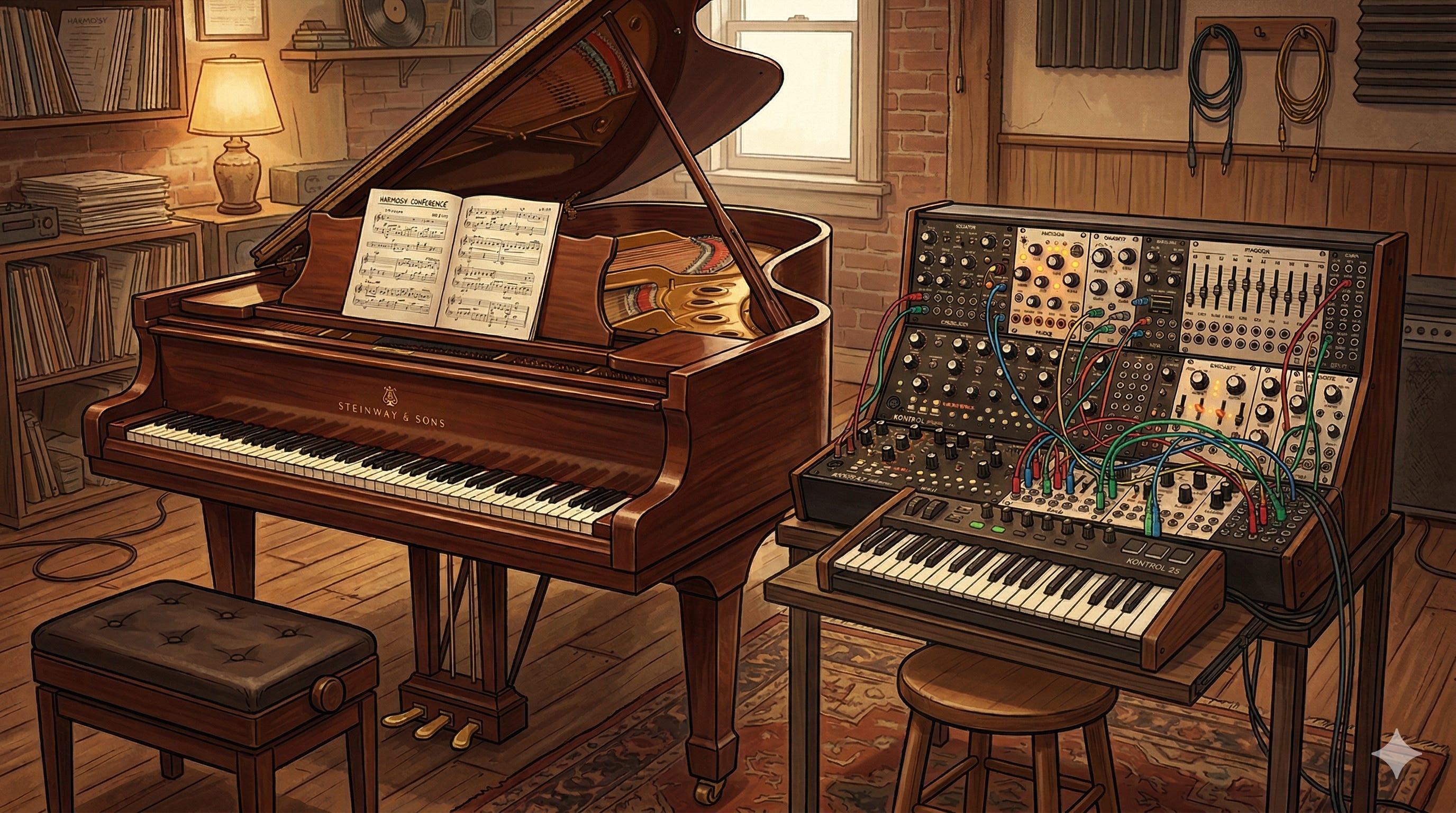
A grand piano and a synthesizer sit side by side, both facing the same sheet music.
Same keys. Same notation. Completely different sound. The piano gives you resonance, warmth, the physical weight of a hammer hitting a string. The synthesizer gives you precision, range, sounds that no acoustic instrument can produce. Nobody asks which one is the “real” instrument. You ask which one this passage needs.
The notation doesn’t care what’s producing the sound. It describes the music: pitch, duration, dynamics, tempo. What happens next depends on what’s in the room and what each instrument does best. Some passages need the depth of the piano. Some need the exactness of the synth. Some need both, and the transition between them needs someone who can hear whether the blend is working.
Skills are becoming the sheet music for work. A notation system that describes what needs to happen without prescribing who or what performs it. The format is converging: the agentskills.io standard and a well-written human performance objective both answer the same questions. What does this thing do? Under what conditions? How do we know it worked?
Neither instrument plays the whole piece alone. The conductor’s job is allocation, not authorship.
♬ Closing Notes
This wraps our four-week skills series. As we’ve seen, skills are no longer a human thing. They are the coordination layer between people and AI agents, and the organizations that build allocation systems around that fact will outperform the ones still assigning work to job titles.
None of this requires better models or bigger budgets. It requires noticing that the vocabulary already shifted and the format already converged.
Final example: this issue was drafted by an agent skill trained on every issue that came before it. I reviewed, revised, and in 3 rounds decided what to publish. That’s the pattern.
For a deeper look, my newest PAICE.work whitepaper “Closing the Collaboration Gap” comes out tomorrow at this year’s ISPI conference.
Until next week,
Sam Rogers Capability Conductor
Snap Synapse - from AI promise to AI practice
The white paper describes the theory. PAICE.work measures the practice. See how your team’s People+AI collaboration actually scores.